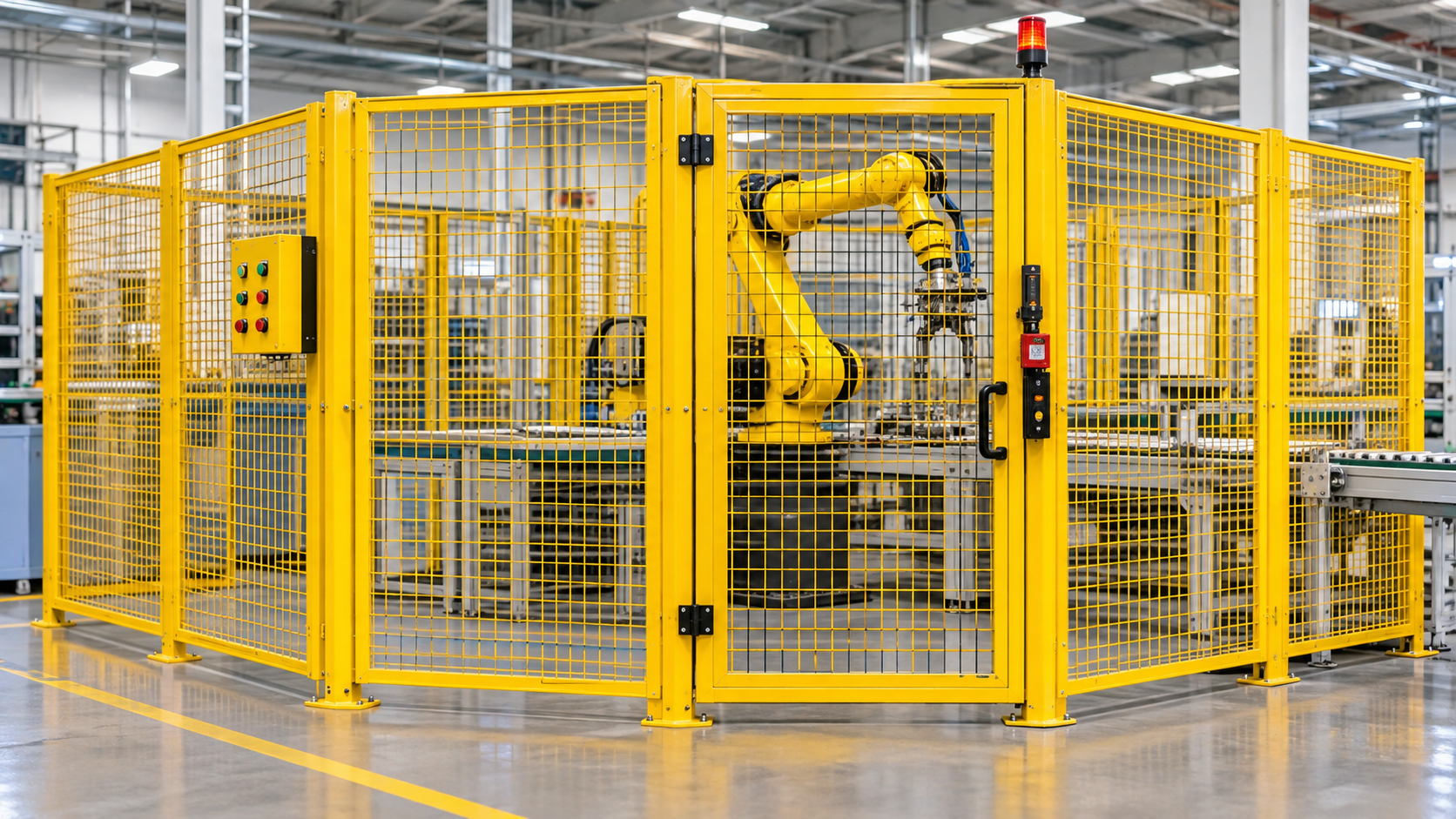
Robot safety fencing is a physical barrier of mesh or solid panels, posts and interlocked doors built around an industrial robot. It keeps people out of the robot’s working area, and when a door is opened the robot can be stopped through its safety circuit.
Why robots need safety fencing
An industrial robot can move fast, carry heavy tools and change direction without warning. Anyone inside its reach can be hit or trapped. A fence stops people walking into that area while the robot works, and an interlocked door lets the robot stop when someone has to go in.
The protection a cell needs is decided by a risk assessment. Fencing is one of the most common results, often combined with light curtains or scanners (see safety fence, light curtain or laser scanner).
The main parts of a robot safety fence
- Panels: welded mesh or solid sheet. Mesh keeps the robot visible. Solid panels close the view and can help contain sparks or debris, depending on the process.
- Posts: floor-mounted posts hold the panels. Fixing them to the floor means no hot work is needed on site.
- Gates and doors: placed where people must enter for loading, setup or maintenance. Interlocked doors carry safety switches so the robot can be stopped when the door opens.
- Openings: cut-outs for conveyors, pipes or cables, sized to the product so gaps stay small.
- Finish: powder coating in safety yellow makes the fence easy to see and protects the steel.
Robot safety fencing vs a full robot cell
Perimeter robot safety fencing guards the area around an existing robot layout. robot cell safety fencing is a complete enclosure designed around one robot, with its tooling, conveyors and operator station.
In machine-guarding standards, fixed panels are called fixed guards and doors that open are movable guards, which should be interlocked. Our guide to robot safety standards explains the main standards.
Where robot safety fencing is used
- Robotic welding cells
- Palletizing and packaging lines
- Machine tending cells
- Material handling between stations
- Automotive and electronics assembly
What to decide before ordering
- Extent and height: set from the robot’s reach and your risk assessment, not a fixed catalogue size.
- Access: where people need to enter, and how often.
- Openings: where conveyors or services pass through.
- Fixing: floor type and layout drawings for the site.
Send us your layout drawing or site measurements and we will reply with a priced proposal.
Common questions
Is a safety fence always needed around an industrial robot?
Not always. The protection needed depends on a risk assessment. Many industrial robot cells use fences, often with light curtains or scanners at openings. Collaborative applications follow different rules.
How tall should a robot safety fence be?
Height depends on the robot’s reach, the hazard and your risk assessment. Standards such as ISO 13857 give safety distances, so we set height from your drawing and assessment rather than a fixed size.
What is the difference between mesh and solid panels?
Mesh keeps the robot visible and lets air and light through. Solid panels close the view and can help contain sparks or debris. Many cells use both.
Send your layout drawing or site measurements to info@robotsafetyfencing.com or on WhatsApp, and see our robot safety fencing and robot cell safety fencing.
Keep reading: