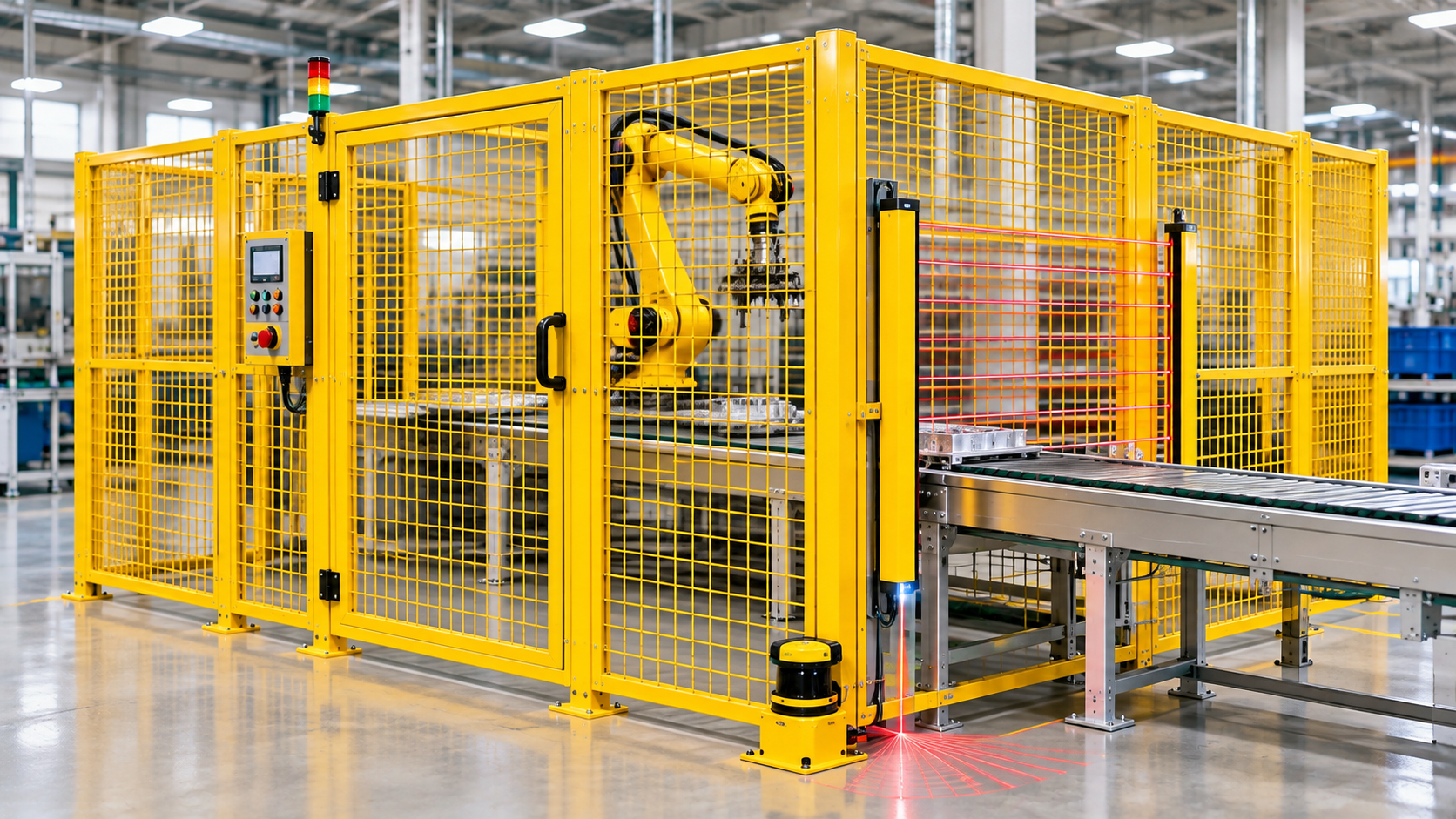
A safety fence physically keeps people out of the robot’s area. A light curtain uses beams of light to detect someone entering an opening, and a laser scanner detects people in a zone on the floor. Many robot cells combine a fence with a light curtain at the loading opening.
Safety fence, light curtain and laser scanner compared
| Safeguard | What it does | Good for | Watch out for |
|---|---|---|---|
| Safety fence | Physical barrier around the cell | Keeping people out and containing sparks, chips or parts | Needs floor space and doors for access |
| Light curtain | Stops the robot when beams across an opening are broken | Frequent loading and unloading openings | Does not contain flying parts; must be placed at a safe distance |
| Laser scanner | Detects people in a zone on the floor | Open or partly open cells where a fence is hard to fit | Does not block anyone; zones must be set correctly |
Why many cells combine them
A common layout is a fence around the cell, a light curtain at the opening where parts are loaded, and an interlocked door for maintenance. Each device covers a gap the others leave. Our robot cell safety fencing includes provisions for light-curtain and scanner mounting, interlocked doors and conveyor cut-outs.
Questions to ask when choosing
- How often do people load parts or enter the cell?
- Can the process throw sparks, chips or parts?
- How much floor space is available?
- Who enters, and why: setup, maintenance or operation?
- How long does the robot take to stop?
Your risk assessment answers these and decides which safeguards are needed.
Teach-pendant and maintenance access
Programming and maintenance need people inside the cell at times. Interlocked doors let the robot be stopped before anyone enters, and we plan access to be teach-pendant friendly. Sensor selection and wiring follow your safety design. Read more about the standards in our robot safety standards guide and the basics in what is robot safety fencing.
Common questions
Can I use a light curtain instead of a safety fence?
Sometimes, for an opening, but it depends on your risk assessment. A light curtain detects people. It does not stop flying parts or physically keep people out, so many robot cells still use a fence.
Do I need a fence if I use a laser scanner?
It depends on the risk assessment and layout. Scanners suit areas where a fence is hard to fit. They detect people but do not block them, so a fence is often used where full containment is needed.
How far should a light curtain be from the hazard?
The distance depends on the robot’s stopping time, the light curtain’s response and resolution, and how people approach. ISO 13855 explains the calculation, so a competent safety engineer should set it.
Send your layout drawing or site measurements to info@robotsafetyfencing.com or on WhatsApp, and see our robot safety fencing and robot cell safety fencing.
Keep reading: